
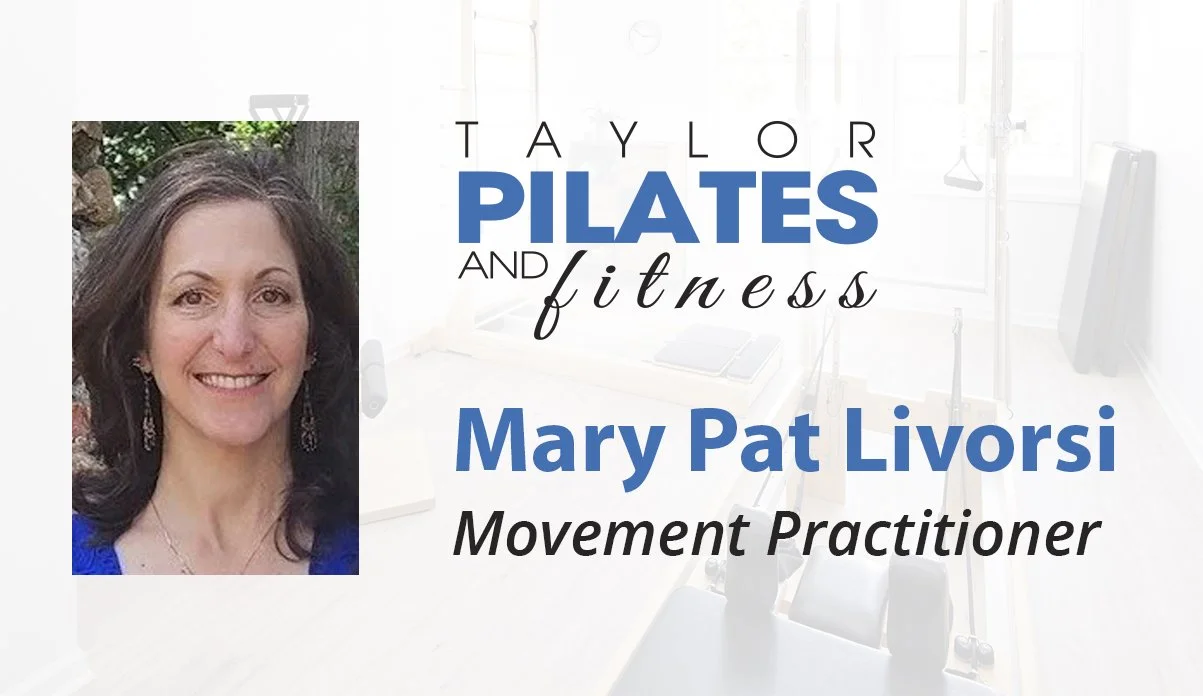
For Mary Pat Livorsi, Pilates is about helping people move better and improve their quality of life. With more than 30 years of experience, she takes a personalized approach to helping clients build strength, move with confidence, and stay active, whether they are recovering from an injury or simply looking to maintain their mobility and independence.
Her Pilates journey began with an injury during college that ultimately led to a lifelong career. We caught up with her to learn more about her background, teaching philosophy, and why she believes Pilates has a place in everyone’s fitness routine.
Q: How did you first become interested in Pilates?
I discovered Pilates when I was studying dance in college in Chicago. I had a hamstring injury that just wouldn’t heal. I’d seen orthopedic specialists, tried massage therapy, and was still having trouble with everyday activities like walking up and down stairs.
One of my instructors suggested I try Pilates. At the time, it was relatively new to Chicago, and there was only one studio in the city.
I started taking private sessions once a week and loved it. As a college student, I didn’t have much extra money, so I’d pack my lunch and dinner to save enough for my Pilates sessions.
What surprised me was how challenging it was. As a dance major, I was taking four hours of movement classes a day, so I thought I was pretty strong. But Pilates challenged me in an entirely different way. By strengthening my core and hamstrings, I was finally able to overcome that injury.
Q: How did that experience turn into a career teaching Pilates?
It happened somewhat by accident. At the time, Pilates instructor training was primarily done through apprenticeships. My instructor was training someone who broke their ankle, and she asked if I’d be interested in learning to teach because I already had a strong anatomy background.
I eventually moved to Texas and completed my certification through Physical Mind Pilates. The process took about a year and a half, and I have continued my education with additional training through STOTT Pilates.
I’ve been teaching since 1994, so I’ve seen the industry change quite a bit!
Q: How have your own experiences with injury influenced the way you teach?
They’ve had a tremendous influence.
While I was training to become an instructor, I was involved in a car accident that caused back problems. I was preparing for my certification exam, which required demonstrating and teaching Pilates exercises. Because of my injury, I couldn’t physically demonstrate everything, so I had to learn how to explain the movements in a way that someone else could understand and perform them.
That turned out to be a blessing. It made me a much better communicator and helped me understand what it’s like to work through an injury.
I know firsthand that sometimes you need to step back, and sometimes you need to push forward. My goal is always to help people progress without causing harm.
Q: You work with clients managing injuries and physical limitations. What do you find most rewarding about that?
Early in my career, I worked with many people who had completed physical therapy but weren’t quite ready to return to the gym or exercise independently. That gave me experience working with people recovering from hip replacements, spinal fusions, and other physical challenges.
Over the years, I’ve also worked with people managing back and neck pain, knee replacements, and neurological conditions.
What I enjoy most is helping people discover that they can do more than they thought possible.
When someone has experienced an injury, it’s natural to become afraid of certain movements. I understand that fear because I’ve experienced it myself. But I don’t want fear to determine what someone can or cannot do.
I want to help people build confidence and gradually expand what they’re capable of doing, always in a safe and healthy way.
Sometimes progress means doing more. Other times, maintaining someone’s current abilities is a meaningful accomplishment. It’s about helping each person enjoy the best quality of life possible.
Q: What do you think people misunderstand about Pilates and how it fits into their overall fitness routine?
That Pilates is easy or that it’s just stretching!
Pilates does help improve flexibility, but it’s also about strength, stability, and control.
Think about hiking in Colorado. When you’re going uphill, your muscles work to propel you forward. When you’re coming downhill, they have to control your movement so you don’t simply fall forward with gravity.
Pilates works on both aspects of movement. With equipment like the reformer, you’re not just pushing against the springs. You’re also controlling the resistance as the springs return.
That’s an important distinction. It’s not about how much resistance you can use or how many repetitions you can complete. It’s about how effectively you can control your body throughout the movement.
I also think people sometimes misunderstand where Pilates fits into their overall fitness routine. Pilates doesn’t replace cardio or other forms of exercise. It’s a complement to them.
I’m a proponent of doing a little bit of everything. You might have an “aha” moment in yoga while doing downward dog, then come back to Pilates and recognize a similar movement that you can take further by working with resistance.
I think Pilates has a place in everyone’s toolkit for maintaining a healthy body.
Q: How would you describe your approach to teaching?
I would describe it as functional Pilates. Rather than simply teaching someone a series of Pilates exercises, I use Pilates to help them improve their everyday life.
I don’t believe in cookie-cutter workouts. Our bodies are different every day, so I always start by asking clients how they’re feeling and what they need that day.
Of course, we repeat certain exercises, but I don’t follow the same routine every session.
I draw from my Pilates background, personal training, and senior fitness training to create an experience that fits the individual.
Ultimately, I want people to be able to do the things that matter to them, whether that’s carrying their own groceries, traveling, climbing stairs, or staying independent as they get older.
Q: Have you had clients who were surprised by what Pilates helped them accomplish?
Absolutely.
I remember one woman who was skeptical because she wasn’t sweating during her sessions. She didn’t feel like she was getting the kind of workout she was used to.
But after she’d been coming for a while, she started noticing changes. Her clothes fit differently, people commented on her appearance, and she could turn around more easily in her car.
I’ve also worked with people who didn’t think they’d be able to travel comfortably because of physical limitations.
One client was concerned about managing stairs while traveling. After we’d worked together for about a year, she went on a trip and found that she could handle more stairs than she expected. She couldn’t do everything, but she could do more than she’d thought possible.
Those are the moments I find most rewarding. It’s not necessarily about how someone looks. It’s about what they’re able to do.
Q: What would you say to someone who wants to try Pilates but thinks they’re not strong or flexible enough?
You have to start where you are.
You don’t need to be flexible, strong, or in great shape before you begin Pilates. You just need to have an open mind and a willingness to learn.
I think people sometimes have a false impression of Pilates because of the images they see. They assume it’s only for young, fit, flexible people, and that’s simply not true.
I’ve worked with people of all ages, shapes, and fitness levels, including clients in their 90s.
Pilates is also a different way of thinking about exercise. Some people approach it as another box to check on their fitness agenda. But it’s not just about completing a workout. It’s about learning how your body moves and developing greater awareness and control.
You don’t necessarily have to work up a sweat or completely exhaust yourself to get stronger.
There’s a learning curve, and that’s okay. We can modify exercises and build from wherever you are. The important thing is being open to the process.
Q: What’s the most important thing you hope clients take away from working with you?
I want them to realize they can do more than they think they can.
I want people to feel stronger and more confident in their bodies, but I also want them to understand how to move intelligently.
It’s not about muscling through an exercise. It’s about learning how to use your body efficiently, starting from your core and working outward.
When you feel better, you’re more likely to stay active and do the things you enjoy. That creates a positive cycle.
My goal isn’t just to teach Pilates. It’s to use Pilates to help people live better.
Q: Finally, what do you enjoy doing when you’re not teaching Pilates?
I love traveling and planning my next adventure!
We’re going to Italy for Christmas, and I’ve been studying Italian for the past year to prepare. I take classes online through a nonprofit organization in the Denver area.
I’m a little nervous that I’ll forget everything I’ve learned once I get there, but I’m looking forward to putting it to use!
Ready to discover what Pilates can do for you? Schedule a session with Mary Pat by calling or texting 303-472-6743.
